Sleep Medicine.

When our sleep is interrupted or not of sufficient duration, the brain is unable to complete all of its work that is designed to take place, in order to restore body and mind.
We know that generally we will function better after that good night’s sleep., but how much of our daily functioning is impaired when we don’t get that quality sleep?
Adequate sleep not only improves our mood and our ability to cope with tasks during the waking hours, but it also strengthens our overall health.
In the background, the quality of sleep that we complete controls hormones that regulate the immune system, blood sugar levels that maintain energy and appetite, repairing cells and tissues and strengthening growth. It is also providing the vessels and heart with rest, needed to maintain safe blood pressure as well as improving minds’ ability in solving problems, concentration and learning.
So what actually is ‘quality sleep’?
So, in order to completely understand the kind of sleep that we need to be providing our body with in order to achieve maximum output., it may be helpful to understand a bit of what actually needs to take place., then it might be more reasonable to assume that the investment in these restful hours., is in fact returned in ways that we sometimes might not even realise after years of functioning on reduced sleep., and having forgotten what our potential might be with that adequate rest. Sound familiar..?
Of course, complex processes are beyond just a page on any website. However… an overview might be suffice in acknowledging the awesome sleep processes., and the incredible returns we get from improving our overall relationship with sleep.
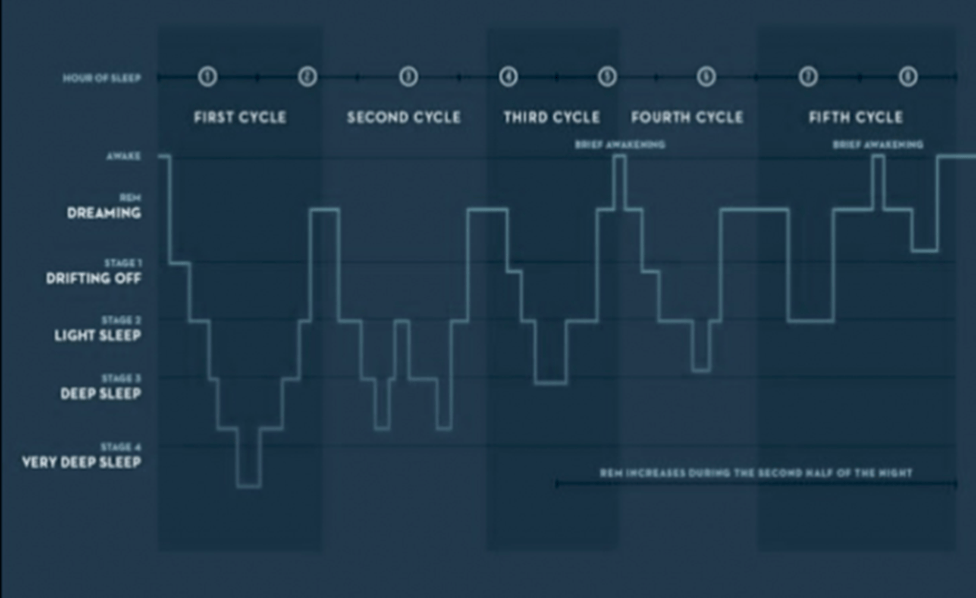
Hypnogram: showing the different stages of sleep during the night.
Some main points…
The {simplified} stages of sleep, as seen on the hypnogram as variations of brainwave cycles during the night, can in simplest terms be described as how difficult it is to wake you up., with light sleep through to ‘dream-state’ REM. As you go deeper into sleep, the brain waves get slower and bigger 1.
So in general., two main phases of sleep lasting 90 minutes and repeated between 4-6 times per night are needed, known as rapid eye movement (REM); this phase is higher increased brain activity, a ‘dream phase’ fight or flight (increased nor/epinephrine etc) or increased stress hormones. And then non-rapid eye movement (NREM), that is very stable and very controlled; a parasympathetic phase from light to deeper sleep where brain is essentially at rest 2.
If nothing else, when working on improving sleep, think of the clearing out jobs, and then the consolidating and strengthening of the valuables..
The Glymphatic System: ‘The Clear Out’.
The clearing out of unnecessaries is essential for obvious reasons, it prevents us from overload of unhelpful information and waste products 3, but also allows us to preserve storage space for what we do want.. or helpful learning, and memories 4.
Clearing out occurs through the slow and deep brain waves that sweep back and fourth, the peak of the waves are where the neurons are active and the trough of the wave is where the neuron are not active., and the waste products are squeezed out from the action between these states. The waste products are metabolite and protein Amyloid-β and Tau, which when left to build up can form plaques and tangles, part of which are thought to play role in dementia and Alzheimer’s 5, 6, 7. We can start to see already where this phase is a useful one to have nailed, for that maximum effect…
Slow wave /deep sleep – is where the energy store is restored., as ATP that can be used though the days’ waking hours as energy gets broken down into somnogenic by-product adenosine., and similarly the deeper sleep then allows for this build-up of sleep substance adenosine; to be cleared away from the brain 8.
Theta
We have two theta stages known to occur, these are learning phases primarily where new memories and new information is created, and one occurs during wakeful hours during the day. However, the daytime hours aren’t able to erase or disregard old information that isn’t of use from the knowledge, therefore it has to be done through REM sleep phase, where the second theta stage takes place: this time able to selectively throw parts of the new information or memory out that is not helpful. If this stage did not occur, the overload of the unhelpful information would reintegrate with memory, and then potentially distort our actual reality, and this is what is thought to occur in mental disturbance, as well some aspects of recurring memory in PTSD. 9, 10, 11.
Theta peaks, are neurons strengthening the synapses or connections, and the REM theta troughs are those connections being weakened in order to control their integration [and therefore our formation of reality, events and surroundings].
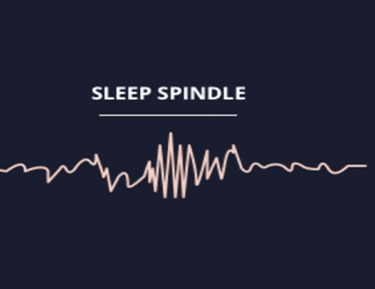
Sleep spindles: Patterns from electroencephalographic (EEG) characteristic of non-rapid eye movement (NREM) sleep and believed to mediate many sleep-related functions such as memory consolidation to cortical development.
A phase of transition into REM, will last around 1.5 seconds and is where the sleep spindle occurs 12. The sleep spindle is an event seen on the hypnogram as a pattern of the wave, like a quick spontaneous reaction, that is thought to occur as learning and forming a memory or new knowledge takes place., signifying that the information has been processed and learned 13.
Therefore ideally, increasing the quality of our sleep, means we are increasing the amount of sleep spindles.. and therefore strengthening our selected knowledge, our focus and concentration and our memory’s.
These events are determined by either shut-down or active levels of chemicals or neurotransmitters, creating the actions that will take place within this circuit. So., neurotransmitter acetylcholine (ACh) is a wake chemical and is in high levels through learning and wakefulness (and even in brain-active REM), but is of course absent in slow wave sleep 14.
Norepinephrine is a stress and learning chemical, and is deactivated during REM and N2 phase sleep 15. Then 5HT levels determine the activity that when this is absent or reduced along with norepinephrine, but with high levels of ACh ; this creates the condition in which the spindles will take place in N2 phase., as the delivery of norepinephrine to structures of the brain (including short-term-learning hippocampus whilst connected to the pre-frontal neocortex) by the locus coeruleus switching between inactive and active, will rapid-fire causing the spindle to terminate and end; and it is this terminating of the spindle and the reaction from neocortex, that is then the information being written into the memory 16.
So., sleep spindles are in a way.., not only a precursor; but also the by-product of good quality and healthy sleep, along with the effective glymphatic clear-out of the waste products.
As well as a healthy sleep routine, can we improve and strengthen spindles? Whilst research is ongoing, it has been shown that stress, age, pain, illness and recreational drugs can reduce both the frequency and density of the spindles taking place, whilst improving calcium channels has been thought to be a potential in enhancing spindle strength and frequency.
Despite much research showing that random or synchronous sounds can artificially induce spindle occurrence., it has also however been shown that these later hindered the wake state, and therefore may not be as productive as naturally induced synchronous sleep environment and nutrient profiling 17.
As we come to understand how complex, but important healthy and quality sleep processes are to our daily functioning; and that so many of us have learned to accept as our optimal way of getting through., we also however see opportunity for where we are able to apply some extra measures in protecting our sleep.. and actually how some very simple lifestyle changes can dramatically improve some of our most challenging moments during the day, following last nights ‘rest’.
Is it time that we invested more in better quality sleep..? Now., let’s talk herbs.
References
1. Patel, A.K., Reddy, V., Shumway, K.R., et al. (2022) Physiology, Sleep Stages. In: StatPearls [Internet]. Treasure Island (FL): StatPearls Publishing.
2. Memar, P., Faradji, F. (2018) A Novel Multi-Class EEG-Based Sleep Stage Classification System. IEEE Trans Neural Syst Rehabil Eng.
3. Hauglund, N. L., Pavan, C., Nedergaard, M. (2016) Cleaning the sleeping brain – the potential restorative function of the glymphatic system. Current Opinion in Physiology, Volume 15,2020.
4. Miyamoto, D., Hirai, D., and Murayama, M. (2017) The Roles of Cortical Slow Waves in Synaptic Plasticity and Memory Consolidation. Laboratory for Behavioral Neurophysiology, RIKEN Brain Science Institute, Japan Society for the Promotion of Science (JSPS), Tokyo.
5. Rasch, B., Born, J. (2012) About Sleep’s Role in Memory. Physiological Reviews. American Physiological Society. 10.1152/physrev.00032.2012.
6. Nagele, R.G., Wegiel, J., Venkataraman, V., Imaki, H., Wang, K.C., Wegiel, J. (2004) Contribution of glial cells to the development of amyloid plaques in Alzheimer’s disease. Neurobiol Aging. 2004;25(5):663–74.
7. Serrano-Pozo, A., Mielke, M.L., Gómez-Isla, T., Betensky, R.A., Growdon, J.H., Frosch, M.P., et al. (2011) Reactive glia not only associates with plaques but also parallels tangles in Alzheimer’s disease. Am J Pathol.
8. Bjorness, T. E., & Greene, R. W. (2009). Adenosine and sleep. Current neuropharmacology, 7(3).
9. Buzsaki, G.(2006) Rhythms of the Brain. Oxford University Press, 2006.
10. Bohbot V.D., Copara, M.S., Gotman. J., Ekstrom A.D. (2017) Low-frequency theta oscillations in the human hippocampus during real-world and virtual navigation. Nat. Commun.
11. Mellman, T., Pigeon, W., Nowell, P., and Nolan, B. (2007). Relationships between REM sleep findings and PTSD symptoms during the early aftermath of trauma. J. Trauma. Stress 20, 893–901.
12. Zhang, Z.Y., Campbell, I. G., Dhayagude, P.. Espino, H.C., and Feinberg, I. (2021) Longitudinal Analysis of Sleep Spindle Maturation from Childhood through Late Adolescence. Department of Psychiatry and Behavioral Sciences, University of California Davis, Sacramento, California.
13. Fogel, S.M., Smith, C.T. (2011) The function of the sleep spindle: a physiological index of intelligence and a mechanism for sleep-dependent memory consolidation. Neurosci Biobehav Rev.
14. Sarter, M., Bruno, J.P. (2000) Cortical cholinergic inputs mediating arousal, attentional processing and dreaming: differential afferent regulation of the basal forebrain by telencephalic and brainstem afferents. Neuroscience. 2000;95(4):933-52.
15. Ding, F., O’Donnell, J., Xu, Q., Kang, N., Goldman, N., and Nedergaard, M. (2016) Changes in the composition of brain interstitial ions control the sleep-wake cycle. Science 352, 550–555.
16. Kjaerby, C., Andersen, M., Hauglund, N. et al. (2022) Memory-enhancing properties of sleep depend on the oscillatory amplitude of norepinephrine.Nat Neurosci.
17. Antony, J.W., Paller, K.A. (2017) Using Oscillating Sounds to Manipulate Sleep Spindles. Sleep. 2017 Mar.1;40(3): zsw068.
Originally published: 11/11/2022
This article was recently reviewed by author for accuracy and updated on 2nd October 2026, to include the latest information and taxonomy.
Whilst every care is taken to ensure accurate, reputable and the most recent sources and research for this information, this content is not intended as substitute for advice or treatment from a professional clinician. As with conventional medicines, herbal and natural medicines have active ingredients and can have potent effects and interactions with the body, medications, and with other conditions. Especially for those who are taking prescription or over-the-counter medications, it is advised to consult a professional herbalist or medical doctor before beginning any herbal, supplement or lifestyle program. Care and responsible administration is always strongly advocated.

