Seasonal Herbal Medicine .i.
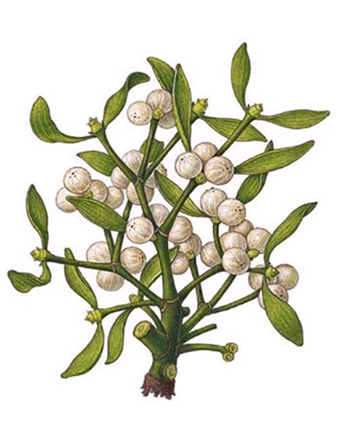
Botanical Name: Viscum album L. Common name: Mistletoe
Botanical Profile Unconventional. documented through history as ‘.. never touches the earth’ 2. V. album does not grow on the earth, instead seeds from the berry are spread via birds to trees. Neither does it follow a conventional 12-month vegetation cycle and flowers in winter. Semi-independent., although it is able to feed through its own photosynthesis, it hosts however on other trees to syphon water and nutrient, most frequently the hosts are Hawthorn (Crataegus laevigata (Poir.) DC.) Lime (Tilia cordata Mill.) and apple trees (Malus domestica Borkh.).
Dioecious Viscum album L. flowers form clusters of tiny 3-5 petals, leaves are obovate, opposite and a white-berry fruit clustering in between 2- 6, contains seeds covered in layers of sticky glutenous substance 3.
Key Phyto Profile: (can vary depending on the host tree that it has grown) lectins, viscotoxins, flavonoids, phenolic acids, sterols, lignans, terpenoids, phenylpropanoids, alkaloids and fatty acids1.
Medicinal Profile
A beautiful herb for insomnia and anxiety state as mild sedative, as well as for fatigue and nervous conditions 4, 5.
It is likely that flavonoids present in V. album may be responsible for the nervine and known effects on the central nervous system (CNS) as these can cross the blood-brain barrier, and to the site of inhibitory neurotransmitter GABA (γ-Aminobutyric acid)6. GABAA receptor ion channels, are opened by the stimulation of GABA resulting in decreased excitatory input, therefore relaxing the excitability7. Subsequently, the cell is inhibited, and the sedative, nervine or anticonvulsant effect occurs.
Furthermore, various flavonoids bind to the [high affinity-benzodiazepine] site and so., sensitising the receptor to GABA, increasing the frequency of the channel opening. These compounds may then be effective for treating insomnia, as a muscle-relaxant or known cognitive effects have shown its’ adjunctive potential in treatment for Alzheimer’s and Parkinson’s Disease8.
However, its medicinal properties have been shown to be broad; both throughout cultures and history for complex conditions such as labour pains (which we may now attribute to its likened qualities to that of oxytocin, a protein of the hypothalamus that facilitates muscles such as the uterus for labour) and fertility complications, bone fractures and menorrhaggia9, 10, 11, 12. More recently [eg this century..]., ongoing studies show clinical evidence supporting efficacy for some cardiovascular conditions [probably due to presence of choline, acetylcholine and GABA], in particularly blood pressure: mainly Hypertension and associated headaches, and Angina pectoris 13,14,15,16.
Clinical studies well document Mistletoe in adjuvant cancer therapy as anticancer agents, inducing apoptosis in cell lines17; particularly in leukaemia, and breast cancer 18, 19.
Some anti-tumour action is owed to its constituents phenolics, terpenoids, and viscumin (mistletoe lectin-1 or ML-1) lectins, that as glycoproteins, they have been shown to help modulate the immune system. Pathways include improving various defence cells (including natural killer cells that can destroy tumour cells, antibodies and also as antiviral)20. It also shows to increase phagocytic (allergic) response, macrophages and cytokines (immune, and inflammatory response), whilst promoting hemopoiesis, or red and white blood cell production21, 22.
References
1. Szurpnicka, A., Zjawiony, J.K., Szterk, A. (2019) Therapeutic potential of mistletoe in CNS-related neurological disorders and the chemical composition of Viscum species. J Ethnopharmacol. 2019;231:241–252.
2.Ramm, H. (1994) The Soil in which Mistletoe-Bearing Oaks Grow. Annual Report Verein fiir Ramm, H. (1995) Die Mistel Dee Zeit. Der Merkurstab, 2, 113-123.
3. Boullemier, L. (1985) The Checklist of Species, Hybrids and Cultivars of the Genus Fuschia. Blandford Press.
4. Bartram, T.H. (1995). Encyclopedia of Herbal Medicine. Grace Publishers, Christchurch, Dorset.p.296.
5. Bisset, N.G. and Wichtl, M. (1994) Mistletoe herb. In: Herbal Drugs and Phytopharmaceuticals. Medpharm GmbH Scientific Publishers, Stuttgart, CRC Press.
6. Vauzour, D., Vafeiadou, K., & Rodriguez-Mateos, A. et al. (2008) The neuroprotective potential of flavonoids: a multiplicity of effects. Genes Nutr3, 115–126 (2008).
7. Allen, M.J., Sabir, S., Sharma, S. (2022) GABA Receptor. In: StatPearls Treasure Island (FL): StatPearls Publishing; Updated: January 2022.
8. Diniz, T. C., Silva, J. C., De Lima-Saraiva, R.G. (2015)The role of flavonoids on oxidative stress in epilepsy. F.P.R.D.A. Ribeiro, A.G.M. Pacheco, R.M. De Freitas, L.J. Quintans-Júnior, J.D.S.S. Quintans, R.L. Mendes, J.R.G.D.S. Almeida Oxid. Med. Cell. Longev., 2015 (2015), p. 9.
9.Howard, H.P. (1892) Mistletoe as an oxytoxic. Medical News, 60, 547–548.
10. Ratera, E.L., Ratera, M.O. (1980) Plantas de la flora Argentina empleadas en Medicina Popular. Hemisferio Sur ed., Buenos Aires, pp. 82–85.
11. Lim, Y.T. (2002) Mistletoe therapy in endometriosis. Fertil Steril. 2002;77(suppl 1) : S53.
12. Fox, S.I. (2002) Human Physiology. 7th ed. New York: McGraw-Hill; 2002.
13. Bone, K. (2008) Viscum album. The Ultimate Herbal Compendium. Phytotherapy Press; 1st edition (31 Dec. 2008).
14. Winterfeld, K., Kronenthaler, A. (1942) Zur Chemie des blut- drucksenkenden Bestandteiles der Mistel (Viscum 20 album), Il. Mitteilung. Arch Pharm 1942;280:103.
15. Winterfeld, K., Bijl, L.H. (1948) Viscotoxin, ein neuer In-haltsstoff der Mistel (Viscum album L.). Justus L-iebigs Annal Chem 1948;561:107-115.
16. Koch, F.E. (1938) Experimentelle Untersuchungen über entzündung-und nekroseerzeugende Wirkung von Viscum album. Z Ges Exp Med 1938;103:740-749.
17. Urech, K., Buessing, A., Thalmann, G., Schaefermeyer, H. & Heusser, P. (2006) Antiproliferative effects of mistletoe (Viscum album L.) extract in urinary bladder carcinoma cell lines. Anticancer Res. 26:3049–3055. 2006.
18. Molassiotis, A., Scott. J.A., Kearney, N., Pud, D., Magri, M.S., et al. (2006) Complementary and alternative medicine use in breast cancer patients in Europe. Support Care Cancer. 14:260–267. 2006.
19. Eggenschwiler, J., Patrignani, A., Wagner, U., Rehrauer, H., Schlapbach, R., Rist, L., et al. (2006) Gene expression profiles of different breast cancer cells compared with their responsiveness to fermented mistletoe (Viscum album L.) extracts Iscador from oak (Quercus), pine, white fir and apple tree (Malus) in vitro. Arzneimittelforschung. 56:483–496. 2006.
20. Schink, M., Troger, W., Dabidian, A., et al. (2007) Mistletoe extract reduces the surgical suppression of natural killer cell activity in cancer patients. a randomized phase III trial. Forsch Komplementmed 2007.
21. Murray, P.R., Rosenthal, K.S., Kobayashi, G.S., Pfaller, M.A. (1998) Medical Microbiology. 3rd ed. St. Louis, MO: Mosby; 1998.
22. Huber, R., Barth, H., Schmitt-Graff, A., Klein, R. (2000) Hypereosinophilia induced by high-dose intratumoral and peritumoral mistletoe application to a patient with pancreatic carcinoma. J Altern Complement Med. 2000;6(4):305-310. Phagocytic
Botanical Information: The Plant List (2013). Version 1.1. Published on the Internet; http://www.theplantlist.org/ (December 2022) and POWO (2026). “Plants of the World Online. Facilitated by the Royal Botanic Gardens, Kew. Published on the Internet; https://powo.science.kew.org/.
Originally published: 13/12/2022
This article was recently reviewed by author for accuracy and updated on 9th October 2026, to include the latest information and taxonomy.
Whilst every care is taken to ensure accurate, reputable and the most recent sources and research for this information, this content is not intended as substitute for advice or treatment from a professional clinician. As with conventional medicines, herbal and natural medicines have active ingredients and can have potent effects and interactions with the body, medications, and with other conditions. Especially for those who are taking prescription or over-the-counter medications, it is advised to consult a professional herbalist or medical doctor before beginning any herbal, supplement or lifestyle program. Care and responsible administration is always strongly advocated.
Apothēcary of Botanical Medicine
South Westminster Centre For Health, 82 Vincent Square, London SW1P 2PF
07873 268646

