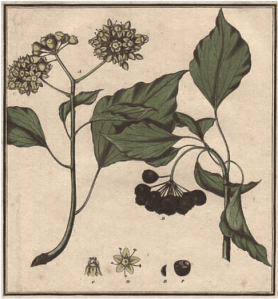
BotanicalName: Hedera helix L. Common name/ Synonyms: English Ivy, True IvyFamily: Araliaceae.
Botanical Profile Leaves are coriaceous, 4–10 cm long and wide, base is cordate, with green upper surface, and a paler, radiate venation. 3-8cm leaves are ovate-rhomboid to lanceolate forming a flowering from summer – late autumn in umbels of 3–5 cm in diameter, bearing small black winter berries.
Collect leaf in late spring – early summer for therapeutic value.
KeyPhyto Profile:Triterpenoid saponins, bidesmosidic glycosides of hederagenin: hederacoside С, hederacoside D (0.4–0.8%), hederacoside В (0.1–0.2%), and α-hederin. Phenolics (flavonoids, anthocyanins, coumarins and phenolic acids), amino acids, steroids, vitamins, volatile and fixed oils, β-lectins and polyacetylenes 1.
A note on toxicity… bad press? Maybe. Actual documented reports suggests that falcarinol contained in fresh Ivy leaves and the leaf juice, can be a potential to cause Allergic Contact Dermatitis, whilst some allergic symptoms have been reported among regular occupational contact with the plant 1,2.
There are no documented health risks or side effects from proper administration of the designated therapeutic dosages3.
Historically, the medicinal and ceremonial qualities of Ivy (H. helix) have been noted as far back as the Roman and Greek Gods prepared as a wine., whilst Botanist and Physician Culpeper noted it’s qualities in ear infections, wound healing, and even for helping in prevention against the plague 4.
Ivy is well documented for its various medicinal actions on many aspects of the respiratory system and its earliest symptoms, and approved by the Committee on Herbal Medicinal Products (HMPC) as an expectorant for chesty coughs5 and symptoms of chronic inflammatory bronchial conditions by the Commission E 6.
Therapeutically, ivy has indeed been associated most efficiently for the common respiratory complaints that are characterised by cough such as Asthma, or other conditions that are generally presentations of an airway obstruction and hyper-secretion of mucus, that additionally may cause symptoms like wheezing or dyspnoea (shortness of breath) 7.
In these instances it is likely that constituent saponins and alpha hederin is responsible for broncholytic and secretolytic action as the expectorant8,9 that is highly beneficial in many respiratory or pulmonary diseases that are accompanied by productive (phlegm producing) cough or presentation.
Mechanisms and pathways of the action include the expansion of the bronchial tubes, increased production of surfactant in the lungs, promotes alveolar function, while also breaking up bronchial secretions and facilitating the expectoration 10, 11.
An uncomplicated acute bronchitis typically presents as a phase of variable constitutional symptoms lasting between one to five days, followed by cough and phlegm production that lasts between one and 3 weeks. A cough lasting for more than 21 days might be defined as subacute or chronic and requires further diagnostic workup12. Studies have shown most specifically., therapeutic preparations of Ivy (H. helix) have been shown to improve the level of the cough., from dry to productive with improved expectoration quality and colour 13, the severity and the duration of the infection, and an overall improvement in the accompanying symptoms of viral bronchitis or respiratory tract infections typically fever, post-nasal drip, nasal congestion, sore throat, sneezing, wheezing, fatigue and body-ache 14.
Inflammatory markers (erythrocyte sedimentation rate, oropharyngeal mucosal congestion and C-reactive protein (CRP) was found in studies to be dramatically improved and reduced in [child] patients with Upper Respiratory Tract Infections after taking Ivy15, whilst there was also a reported reduction in overall night time respiratory related pain, less night time coughing and less disturbed sleep, and a significantly improved night-cough frequency and sleep quality 16.
Finally, parameters measured within the clinical studies also found a reduction in the need for prescribed antibiotics for those who treated symptoms of upper respiratory tract early on with Ivy preparations 18.
Whilst the active mechanisms make Ivy a useful therapeutic in the management of symptoms of the infection, there is also substantive foundation for evidences that suggests that there may also be association to antimicrobial activity on various strains of bacterial and fungal infections.
Combination of the leaf of H. helix saponins with hederacoside C, exhibited the activity against 23 strains tested (22 bacteria and one yeast strain): Gram-positive bacteria (staphylococcus spp., bacillus spp., Enterococcus spp., streptococcus spp.) and Gram-negative bacteria (Salmonella spp., Shigella spp., Pseudomonas spp., Escherichiacoli, Proteusvulgaris) and Candida albicans 17.
H. helix leaf water extract from leaves also inhibited the growth of Staphylococcus aureus (standard strain) as well as bacteria and dermatophytic fungi isolated from: Pseudomonas aeruginosa, Trichophyton rubrum, T. mentagrophytes, Microsporum canis, Escherichia coli and Candida albicans17.
The leaves are known to contain polyacetylenes: falcarinone and falcarinol that are also responsible for these active antibacterial and antifungal effects 1.
As antiviral, clinical studies have shown that Ivy has been shown effective against some various viral genotypes and genogroups of enteroviruses , and although more specific research is needed in the area, previous clinical studies show that generically triterpenoid saponins inhibit viral nucleotide synthesis against herpes simplex virus type-1., and the hederasaponin B found as a major compound in Ivy extract preparations., is largely identified as that of triterpenoid saponin group 19. Further studies have shown Hederacoside C to have antiviral activity against the influenza virus A2/Japan-305 at dependant concentration of 100 μg/ml 20.
Aswell as these actions, Ivy has been shown very effectively anti-spasmolytic not only due to saponin composition, there are various other components such as flavonol derivatives and dicaffeoylquinic acids that make it useful for restless muscles or related conditions 1, 22.
Application of a Hedera-saponin complex (hederacoside C, B and α-hederin) has been documented in treatment for cellulitis (liposclerosis), as an antipruritic and emollient for itchiness relating to skin disorders in creams and lotions prepared from extracts of the Hedera helix21.
Hederacoside C combined with α-Hederin have also shown to exhibit antioxidant and numerous clinical trials found that it reduced and displayed protection against specific induced liver injury, and comparable to model antioxidants BHA and BHT and α-tocopherol 23.
Research continues into exact medicinal pathways and actions for the use of Ivy to the best of all its uses.
It is valuable to know of potential lines for further research for effectively preventing, either alone or adjunctive treatment or management of the symptoms of challenging conditions, as we have have possibly seen more recently following the climate of the COVID-19 infection. This was characterised often by its earliest symptoms of cough, accompanied by fever, fatigue, dyspnoea and increased sputum production also frequently presented 24. Furthermore, the after effects of COVID-19 (PACS), known as long-Covid were also reported long after the onset or presence of infection had ceased 25.
Could an Ivy preparation be a contender in the quest for the management of symptoms or for an improved treatment outcome for acute respiratory viral infections or chronic respiratory disease..? I would certainly choose Ivy prepared in drops, syrup or as herb infused tea with a spoon of honey.. up there amongst the super herb greats., sure to see me through any bleak and blustery seasonals’.
Reference
1. Wichtl, M. (2004) Herbal Drugs and Phytopharmaceuticals. A Handbook for Practice on a Scientific Basis. 3rd ed. Stuttgart 2004.
2. Jors, E. (2003) The prevalence of skin and mucosal symptoms in gardeners handling Ficus benjamina (weeping fig) and Hedera helix (ivy). A cross-sectional study. Ugeskr Laeger 2003.
3. Gruenwald, J., Brendler, T., Jaenicke, C. (2000) PDR for Herbal Medicines. Medical Economics Company, Montvale, 2000.
5. Committee on Herbal Products HMPC (2017) Final Assessment Report Hedera helix L., folium. European Medicines Agency. EMA/HMPC/325715/2017. November 2017.
6. Blumenthal, M. (2000) Herbal Medicine Expanded Commission E. Monographs. 1st ed. Austin 2000: 215-218.
7. Holzinger, F., Chenot, J.F. (2011) Systematic review of clinical trials assessing the effectiveness of ivy leaf (hedera helix) for acute upper respiratory tract infections. Evid Based Complement Alternat Med.
8. Sieben, A., Prenner, L., Sorkalla, T., Wolf, A., Jakobs, D., Runkel, F. & Häberlein, H. (2009). Alpha-hederin, but not hederacoside C and hederagenin from Hedera helix, affects the binding behavior, dynamics, and regulation of beta 2-adrenergic receptors. Biochemistry. 2009 Apr, 21.
9. Trute, A., Gross, J.,, Mutschler, E., Nahrstedt, A. (1997) In vitro antispasmodic compounds of the dry extract obtained from Hedera helix. Planta Med. 1997 Apr; 63(2).
10. Sieben, L., Prenner, T., Sorkalla, A., Wolf, D., Jakobs, F. Runkel, & H. Häberlein., (2009) α-Hederin, but not hederacoside c and hederagenin from Hedera helix, affects the binding behavior, dynamics, and regulation of β2– adrenergic receptors. Biochemistry, vol. 48, no. 15, pp. 3477–3482, 2009.
11. Cwientzek, U., Ottillinger, B., Arenberger, P. (2011). Acute bronchitis therapy with ivy leaves extracts in a two-arm study. A double-blind, randomised study vs. an other ivy leaves extract. Phytomedicine. 2011 Oct 15;18(13):1105-9.
12. R. Gonzales & M. A. Sande, (2000) Uncomplicated acute bronchitis. Annals of Internal Medicine, vol. 133, no. 12, pp. 981–991, 2000.
13. Safina, A.I. (2014) Treatment of young children with recurrent acute respiratory tract infections with a herbal combination of thyme herb and ivy leaf. Z.Phytother. 2014;35:262–267.
14. Ali Z., Daniyal, M., Adhia, M.K., Alam A., Sarfaraz, B., Sattar, A. (2017) To evaluate the efficacy and safety of CofNovex plus (EMA) syrup. Pak. J. Pharm. Sci. 2017;30:591–596.
15. Safina, A. I. (2014) Treatment of young children with recurrent acute respiratory tract infections with a herbal combination of thyme herb and ivy leaf. Z. Phytother. 35 (2014) 262–267.
16. Eden, A.B., Perko, J., Tercelj, R., Kreft, S. (2011) Treatment of acute respiratory infections in Slovenian children with ivy leaf extract syrup. Zdravniski Vestnik. 2011;80:276–284.
17. Cioaca, C., Margineanu, C., Cucu, V. (1978) The saponins of Hedera helix with antibacterial activity. Pharmazie 1978; 33(9):609-10.
18. Konrad, M, Adarkwah, C.C., Kostev, K. (2020) Reduced antibiotic use after initial treatment of acute respiratory infections with phytopharmaceuticals- a retrospective cohort study. Postgrad Med. 2020 Jun;132(5):412-418.
19. Han, L.T., Fang, Y., Li, M.M., Yang, H.B., Huang, F. (2013) The Antitumor Effects of Triterpenoid Saponins from the Anemone flaccida and the Underlying Mechanism. Evid Based Complement Alternat Med. 2013.
20. European Pharmacopoeia. 7th ed. Monograph. 01/2008:2148.
21. Herbal Medicine Expanded Commission E. Monographs. 1st ed. Austin 2000: 215-218.
22. Trute, A., Gross, J., Mutschler, E., Nahrstedt, A. (1997) In vitro antispasmodic compounds of the dry extract obtained from Hedera helix. Planta Med 1997; 63(2):125-9.
23. Gülçin, I., Mshvildadze, V., Gepdiremen, A., Elias, R. (2004) Antioxidant activity of saponins isolated from ivy:alpha-hederin, hederasaponin-C, hederacolchiside-E and hederacolchiside-F. Planta Med 2004;70(6):561-3.
24. Wang, L., Wang, Y., We, D., & Liu, Q. (2020) Review of the 2019 novel coronavirus (SARS-CoV-2) based on current evidence. Int J Antimicrob Agents. 2020 Jun;55(6):105948.
25. Tleyjeh, I.M., Saddik, B., AlSwaidan, N., AlAnazi, A., Ramakrishnan, R.K., Alhazmi, D., Aloufi, A., AlSumait, F., Berbari, E.,, Halwani, R. (2021) Prevalence and predictors of Post-Acute COVID-19 Syndrome (PACS) after hospital discharge: A cohort study with 4 months median follow-up. PLoS One. 2021.
Botanical Information: The Plant List (2013). Version 1.1. Published on the Internet; http://www.theplantlist.org/ (December 2022) and POWO (2026). “Plants of the World Online. Facilitated by the Royal Botanic Gardens, Kew. Published on the Internet; https://powo.science.kew.org/.
Originally published: 17/12/2022 This article was recently reviewed by author for accuracy and updated on 5th October 2026, to include the latest information and taxonomy.
Whilst every care is taken to ensure accurate, reputable and the most recent sources and research for this information, this content is not intended as substitute for advice or treatment from a professional clinician. As with conventional medicines, herbal and natural medicines have active ingredients and can have potent effects and interactions with the body, medications, and with other conditions. Especially for those who are taking prescription or over-the-counter medications, it is advised to consult a professional herbalist or medical doctor before beginning any herbal, supplement or lifestyle program. Care and responsible administration is always strongly advocated.
Botanical Nomenclature: The Plant List (2013). Version 1.1. Published on the Internet; http://www.theplantlist.org/ (August 2022).
Whilst every care is taken to ensure accurate, reputable and the most recent sources and research for this information, this content is not intended as substitute for advice or treatment from a professional clinician. As with conventional medicines, herbal and natural medicines have active ingredients and can have potent effects and interactions with the body, medications, and with other conditions. Especially for those who are taking prescription or over-the-counter medications, it is advised to consult a professional herbalist or medical doctor before beginning any herbal, supplement or lifestyle program. Care and responsible administration is always strongly advocated.
Apothēcary of Botanical Medicine
South Westminster Centre For Health, 82 Vincent Square, London SW1P 2PF