Seasonal Herbal Medicine .iii.
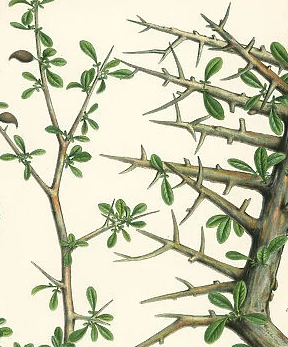
Botanical Name: Commiphora myrrha (T.Nees) Engl. Synonyms: Myrrh. Family: Burseraceae.
Botanical Profile The small tree can grow up to 5m high and 1.5m wide, mostly deciduous with a 3-foliate, oblong to oval leaf, small polygamous flowers on spiny branches 1.
Collected after injuring the tree by making incisions in the stem of the Commiphora myrrha tree, known as ‘tapping’ the bark of the plant causing the tree to bleed or weep the reddish-brown gum oleo resin exude. On exposure to air, the gum resin hardens. Myrrh can then be harvested from the medicinal plant Commiphora myrrha.
Myrrh coming from the word ‘bitter’, is a resin from the Commiphora myrrha trees that are native through dry lands of the Red Sea and Arabian peninsula, indigenous to the Northern Somalia, Kenya, Yemen, Ethiopia, mountain slopes. The trees grow in open wild bushland, over limestone preferring in shallow soils 2.
Medicinal Profile
Medicinal Action Highlights: Antibacterial, anti-inflammatory, Anticancer, Immunomodulatory, Hepatoprotective, Astringent, Anti-catarrhal, Expectorant, Stomachic, Tonic 7.
Key Phyto Profile: Essential oils, gum (30–60%, water-soluble), myrrhol (3–8%, ether-soluble).
Resin: Tannins, Flavonoids, Alkaloids, Glycosides, Steroids, Saponins, and Terpenoids 3.
Essential oil: Heerabolene, Elemol, Acadinene, Cuminaldehyde, Eugenol, Furano-sesquiterpenes incl. furanodienone, furanodiene, curzerenone, and lindestrene 4, 5, 6.
A vast traditionally-medicinal, and of course ceremonial history places C. myrrha in it’s undisputed position of valuable phyto-‘greats’.
In ancient mythology, the legend of cursed Myrrha, daughter of the King of Cyprus, pleaded to the Gods in grief, to transform her into a tree after being chased and banished from her fathers’ kingdom 8. The aromatic exudate of the myrrh tree formed as legend from her tears, the so called “tears of myrrh”.
The manuscripts of Hippocrates report medicinal use of C. myrrha in ancient Rome times 9.
From around 3000 BCE Ancient Egyptians applied the fragrant and antiseptic resin in treating wounds, embalming of the sarcophagi, as well as burnt for religious sacrifices 10.
It was of course among the gifts given to the infant Jesus by the magi 11.
Myrrh, in form of Essential Oil., is frequent as an adorning agent, incense, and bioactive agents largely made up of terpenes and terpenoids. Sesquiterpene lactones are perhaps a main active constituent of pharmaceutical interest 12, and frequent for treating conditions across systems of medicine., such as mouth ulcer, skin conditions, aches, stomach disorders, and microbial infection. In Unani medicine., gums are used as antiseptic, astringent, emmenagogue, and expectorant 13.
Combined with other drug agents, C. myrrha has been useful in preventive medicine against epidemic diseases and used in joint pain and associated conditions such as gout 14. Specifically, it is the lindestrene furanoeudesma-1,3-diene and furanodienes curzerene sesquiterpenes that are the sources of the analgesic property, as well as its aromatic quality 15. Further studies show that analgesic action is mediated by the compounds suppressing the prostaglandin molecule and inhibiting the inward sodium current, and therefore reducing the pain sensation 11. It is also well documented that the levels of compound furanodiene, further lowers pain specifically that is associated from fever 16.
One of the oldest healing and anti-inflammatory medicines due to its phytochemical constituents, it is thought that Commiphora myrrha helps reduce and modulate inflammatory conditions by suppressing pro-inflammatory signalling pathways and strengthening the anti-inflammatory agents 17. It was also found that long-term treatment with myrrh may help to reduce the synthesis of IL-1β – stimulated IL-6 and interleukin-8 (IL8) 18. Lab studies found that C. myrrha exposure decreased the inflammatory response in patients with oral-inflammatory conditions.
This anti-inflammatory activity, alongside the known analgesic, antibacterial and expectorant action known to be found in both the resin and the essential oil of C. myrrha, makes it a strong potential for the treatment of respiratory conditions, where there is infection present 19, 20.
C. myrrha has been shown to attribute bactericidal, fungicidal, and anti-viral activities on different virus strains 21, acting by free viral particles direct inactivation and disrupting the virion envelope structures that have major roles in host cell virus invasion. The C. myrrha essential oils demonstrated antiviral activity against viruses: herpes simplex virus type 1 (HSV-1) and influenza virus type A (H1N1) 22.
In the aftermath of the recent Covid-19 outbreak, as research on the properties of Myrrh and of its potential in the treatment of the virus continues, an interesting study considers the efficacy of therapeutic agents in the form of Myrrh mouthwash among medicinal possibilities to control the spread of the virus 23.
Various studies on the various known pathways of C. myrrha, in particularly focus on constituent elemene and its effects on cancerous cell behaviour including glioblastoma, and have led to the identification of Myrrh by ethnopharmacological evaluation., as possessing anti-cancer actions. C. myrrha was shown to be both effective, as well as safe. Specifically, β-elemene, was reported to exhibit anti-proliferative action 24. It acts on the activation of p38MAPK in glioblastoma (Yao et al. 2008). Furthermore, sesquiterpene compounds have been isolated from myrrh, that have been reported to possess low cytotoxic activity on MCF-7 cell line of breast cancer, showing an potential in reducing the breast cancer growth 25, 26.
Some studies have found that Myrrh is also phyto-nootropic; exerting activity on the brain that improves memory or learning retention 27. Similarly, it is known that C. myrrha may be effective as neuroprotective and strengthens against symptoms of Alzheimer’s Disease showing ability to inhibit Acetylcholinesterase (AchE) 28, 29.
References
1. CCRUM (1973) Standardization of Single Drugs of Unani Medicine. Part III. 1973, 266-271.
2. Lindley, J. (2001) Flora Medica. New Delhi 2001, 171, 173, 243, 27, 594.
3. Shameem, I. (2018) Phytochemical & therapeutic potentials of Murr Makki (Commiphora myrrha): A review. Indian J Appl Res, 8, 102-4.
4. Hanus, L.O., Rezanka, T., Dembitsky, V.M. et al (2005) Myrrh—Commiphora chemistry. Biomed Pap Med Fac Univ Palacky Olomouc Czech Repub 149:3–27.
5. Vishakha, K., Ramyasree, D. (2015) Evaluation of antibacterial activity of Commiphora myrrha against antibiotic resistant clinical pathogens. Indian J Pharm Biol Res 3:07–11.
6. Chandrasekharnath, N., Mahlakshmi, Y.V., Jayalakshmi, L., Venkanna, B., & Uma, A. (2013) Screening and isolation of bioactive factors from Commiphora myrrha and evaluation of their antimicrobial activity. IJERA. 2013;3:1291–1294.
7. Batiha, G.ES., Wasef, L., Teibo, J.O. et al.(2022) Commiphora myrrh: a phytochemical and pharmacological update. Naunyn-Schmiedeberg’s Arch Pharmacol (2022).
8. Ovid, Metamorphoses X, 298-502. Online:https://www.loebclassics.com/view/ovid-metamorphoses %5B13/12/2022%5D
9. Shen, T., Li, G. H., Wang, X. N., & Lou, H. X. (2012). The genus Commiphora: a review of its traditional uses, phytochemistry and pharmacology. J Ethnopharmacol, 142, 319-30.
10. Iskander, Z., Shahin, A.E. (1973) Temporary stuffing materials used in the process of mummification in ancient Egypt. Annales du Service des Antiquités de l’ Égypte, 61, 65-78.
11. Nomicos, E. Y. H. (2007) Myrrh: medical marvel or myth of the Magi? Holistic nursing practice, 21, 308-323.
12. Singh, R. (2015) Medicinal plants: a review. J Plant Sci 3:50–55.
13. Batiha, G.ES., Wasef, L., Teibo, J.O. et al.(2022) Commiphora myrrh: a phytochemical and pharmacological update. Naunyn-Schmiedeberg’s Arch Pharmacol (2022).
14. Venkatesha Murthy, C.G. (2011) Understanding personality from Ayurvedic perspective for psychological assessment: a case. Ayu. 2011;32:12–19.
15. Dolara, P., Luceri, C., Ghelardini, C. et al (1996) Analgesic effects of myrrh. Nature 379:29–29.
16. Gadir, S.A., Ahmed, I.M. (2014) Commiphora myrrha and commiphora Africana essential oils. J Chem Pharm Res 6:151–156.
17. Anjum, K. et al. (2017). Current status and future therapeutic perspectives of glioblastoma multiforme (GBM) therapy: A review. Biomedicine and Pharmacotherapy, 92, 681-689.
18. Moran, J., Addy, M. & Roberts, S. (1992). A comparison of natural product, triclosan and chlorhexidine mouthrinses on 4‐day plaque regrowth. Journal of clinical periodontology. 19, 578-582.
19. Su, S., Wang, T., Duan, J-A. et al (2011) Anti-inflammatory and analgesic activity of different extracts of Commiphora myrrha. J Ethnopharmacol 134:251–258.
20. Germano, A., Occhipinti, A., Barbero, F. et al (2017) A pilot study on bioactive constituents and analgesic effects of MyrLiq®, a Commiphora myrrha extract with a high furanodiene content. BioMed Res Int 2017.
21. Khalil, N., Fikry. S., Salama, O. (2020) Bactericidal activity of Myrrh extracts and two dosage forms against standard bacterial strains and multidrug-resistant clinical isolates with GC/MS profiling. AMB Express 10:21.
22. Brochot, A., Guilbot, A., Haddioui, L. et al (2017) Antibacterial, antifungal, and antiviral effects of three essential oil blends.Microbiologyopen 6:e00459.
23. Alyafei, N. (2020) Can Myrrh Combat COVID-19? Iberoam J Med: 0–0.
24. Yao, Y-Q., Ding, X., Jia, Y-C. et al (2008) Anti-tumor effect of β-elemene in glioblastoma cells depends on p38 MAPK activation. Cancer Lett 264:127–134
25. Shen, T., Lou, H-X (2008) Bioactive constituents of myrrh and frankincense, two simultaneously prescribed gum resins in Chinese traditional medicine. Chem Biodivers 5:540–553
26. Yeo, S.K, Ali, A.Y., Hayward, O.A et al (2016) β-Bisabolene, a sesquiterpene from the essential oil extract of opoponax (Commiphora guidottii), exhibits cytotoxicity in breast cancer cell lines. Phy- tother Res 30:418–425.
27. Hussein, B.A., Karimi. I., Yousofvand, N. (2019) Computational insight to putative anti-acetylcholinesterase activity of Commiphora myrrha (Nees), Engler, Burseraceae: a lessen of archaeopharmacology from Mesopotamian Medicine I. In Silico Pharmacol 7:3.
28. Yu, Y-F., Liu, Y-H., Chen, X-H et al (2020) Cadinane type sesquiterpenes from the resinous exudates of Commiphora myrrha and their anti-Alzheimer’s disease bioactivities. Fitoterapia 142:104536
29. Teibo, J., Bello, S., Olagunju, A. et al (2020) Functional foods and bio- active compounds: roles in the prevention, treatment and management of neurodegenerative diseases. GSC Biol Pharm Sci 11:297–313.
Botanical Information: The Plant List (2013). Version 1.1. Published on the Internet; http://www.theplantlist.org/ (December 2022) and POWO (2026). “Plants of the World Online. Facilitated by the Royal Botanic Gardens, Kew. Published on the Internet; https://powo.science.kew.org/.
Originally published: 23/12/2022
This article was recently reviewed by author for accuracy and updated on 8th October 2026, to include the latest information and taxonomy.
Whilst every care is taken to ensure accurate, reputable and the most recent sources and research for this information, this content is not intended as substitute for advice or treatment from a professional clinician. As with conventional medicines, herbal and natural medicines have active ingredients and can have potent effects and interactions with the body, medications, and with other conditions. Especially for those who are taking prescription or over-the-counter medications, it is advised to consult a professional herbalist or medical doctor before beginning any herbal, supplement or lifestyle program. Care and responsible administration is always strongly advocated.
Apothēcary of Botanical Medicine
South Westminster Centre For Health, 82 Vincent Square, London SW1P 2PF
07873 268646

