Meet thy Medicine.

Cold and dark mornings of January. If you have found your mood is particularly low in the last few days., then you’re not alone. In fact, the third Monday of January is looming., typically termed ‘Blue Monday’ and is widely termed the saddest day of the year.
A ‘social myth’? Maybe so, with very little medically-specific or clinically supportive explanations. However, actually., many of us really do significantly experience the effects of a seemingly post-event trigger for the {temporary} low mood, or lack of motivation type of response. And perhaps this is reasonable as we look back on the excitement of Decembers’ festivities., the weather is drawing out those longer nights., and potentially., we may now even need to face the financial reality of the previous party season too.
Biologically, there are many possible explanations for this too., as through the reduced sunlight hours we grapple with altered serotonin activity, reduced Vitamin D and the inevitable disruption in our circadian rhythm that can lead us to feeling fatigued, low in energy and just a bit lacking in motivation 1, 2.
However., whilst we let go of 2023., we look to the promise of the new year and the opportunity for embracing this temporary retreat, until we feel rejuvenated enough to emerge through the surface, and ready for action.
Thankfully, there are practical things that we can do to make this process both nourishing and enjoyable.
My favourite things usually start with, or involve the word nature., and connecting with nature is [as always…] going to be first foundation for any medicines that I consider for promoting any kind of healing, and/ or that is worth sharing.
This can be interpreted relatively liberally., in particularly relevent perhaps for city dwellers. To some people it may be the daily outdoor walk in the park [let’s call this Shinrin-yoku or Forest Medicine] 3 or for others it may be updating your indoor plant collection [we’ll call this one.. Biophilia] 4.
Often hand-in-hand with this, is exposure to natural sunlight, also a big contributor to mood, whilst also strengthening circadian activities that include our diet and nutrition, exercise, our rest and our sleep rhythm 5, 6.
Now that the terrain is created for our star herb for January to work its medicinal action at its best., meet Albizia Julibrissin.
Botanical Name: Albizia julibrissin Durazz. Synonyms: Silk tree, Mimosa.
‘Tree of Happiness’
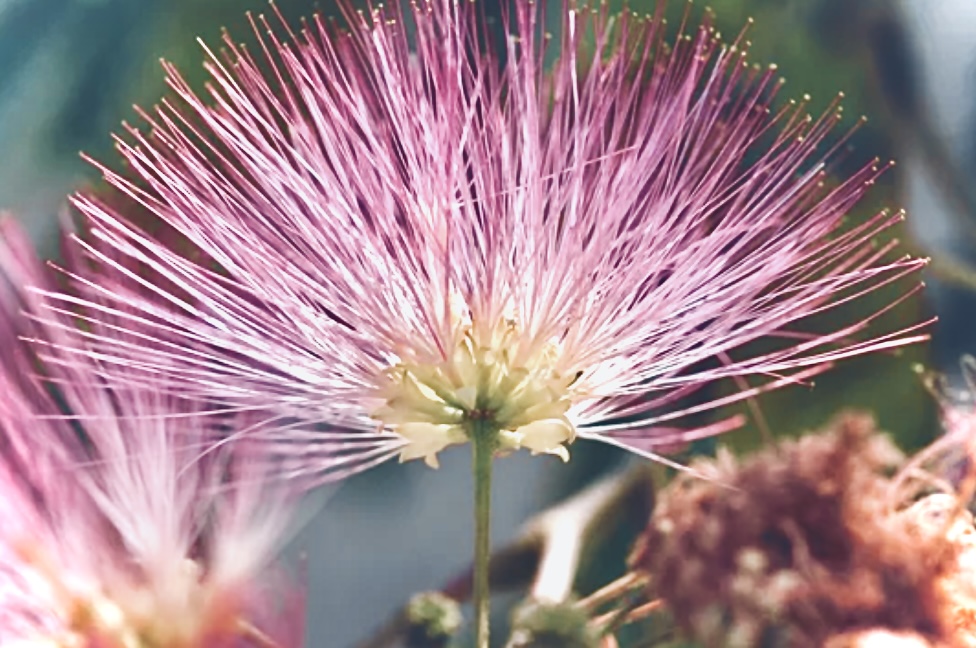
Botanical Profile Albizia julibrissin Durazz. is a small to medium in height shrub or tree with a spreading crown.
Large, bipinnately compound leaves with 10-35 pairs of mainly oblong leaflets and alternate along the stems. Leaves of this shrub may close up at nighttime, or in rainy conditions. Terminal clusters of pink flowers are arranged in panicles at ends of branches, and fruits are flat, straw-coloured pods that contain light brown oval-shaped seeds 7, 8.
Key Phyto Profile: Alkaloids, triterpenoids, lignans, flavonoids, saponins, and sterols. Flowers contain volatile oils 9, 10.
Medicinal Action Highlights: Sedative 11, Anxiolytic 12, Antiinflammatory, immune-modulating 13, Antioxidant 14, Neuroprotective 15, Anti-tumour 16, Antidepressant 17.
Some major bioactive phytomedical contributors:
Particularly, the discovery of saponin JC1 appears to be the active constituent for anxiolytic as well as anti-insomnia effects 18.
Flavonoids contribute major active antioxidant components for proposed neuroprotective and cognitive effects. The antioxidant pathways are found to be protective against apoptosis of neurons induced by oxidative stress in short-term sleep deprivation and insomnia 19.
Saponins are likely to be the active anti-neoplastic principal.
Saponins and alkaloids [being poorly dissolved in water] have been proposed as main bioactive component for the effect against memory loss, and in particularly for memory loss that is due to sleep disruption 20.
Albizia julibrissin is known as The Tree of Happiness., perhaps from the traditional Chinese Materia Medica (神农本草经) (Han Dynasty, 25A.D.) relating to its listed medicinal properties., that it could comfort the internal organs, benefit the mind and make people happy and worry-free 21. Both the bark and flowers have medicinal qualities used in herbal medicine., the flowers that are said ‘to lighten the spirit’ and the bark that is said ‘to anchor the spirit’. Fluid extracts that combine both the flowers and bark, may be taken together, traditionally used today in Chinese Medicine and some Western practice for suffering caused by severe grief or loss.
A. julibrissin has many associations and continues to be studied for its actions in improving cognitive disturbances in particularly resulting from sleep disruption 22, memory deficit, emotional strengthening, and to help with irritability and insomnia 23.
And as our favourite plants of nature prepared for the cold seasons as they’ve shed their leaves… reducing those paths that would usually carry water between their roots and leaves in order for them to reduce any risks that the harsh frosts brings., or like the tulips that retreated their seeds underground to safety until spring., we too are able to retreat just temporarily… perhaps even engaging in some of those activities that can deeply nourish our own roots…, until we too feel rested and hardy., enough to emerge for the springtime.
Suggested dose: 1 tsp (5ml), twice daily.
Reference
1. Abbas, S. A., Khan, U. A. & Helal Uddin, A. B. M. (2011) Seasonal changes effects on the serotonin and melatonin transmission. Canadian Journal of Applied Sciences; Vol. 1(1), pp. 01-09. Intellectual Consortium of Drug Discovery & Technology Development.
2. Lucas, R. M., Ponsonby, A. L., Dear, K., Valery, P., Taylor, B., van der Mei, I, et al. (2013) Vitamin D status: multifactorial contribution of environment, genes and other factors in healthy Australian adults across a latitude gradient. J Steroid Biochem Mol Biol. 2013; 136:300–8.
3. Ohtsuka, Y., Yabunaka, N., & Takayama, S. (1998) Shinrin-yoku (forest-air bathing and walking) effectively decreases blood glucose levels in diabetic patients. Int J Biometeorol. 1998; 41:125–7.
4. Deshun, Z. set al (2023) Promoting adult health: the neurophysiological benefits of watering plants and engaging in mental tasks within designed environments. BMC Psychol 11, 310.
5. Rosenthal, N. E., Sack, D. A., Davenport, Y., et al. (1984). Seasonal affective disorder: A description of the syndrome and preliminary findings with light therapy. Arch. Gen. Psychiatry 41, 72–80.
6. Wehr, T. A., and Rosenthal, N. E. (1989). Seasonality and affective illness. Am. J. Psychiatry 146, 829–839.
7. Orwa, C., Mutua, A., Kindt, R., Jamnadass, R., & Simons, A. (2009) Agroforestree Database: a tree reference and selection guide. Albizia julibrissin. Version 4.0. World Agroforestry Centre, Kenya. https://www.worldagroforestry.org/output/agroforestree-database. Accessed: on 03-01-2024.
8. The International Plant Names Index and World Checklist of Vascular Plants 2024. Albizia julibrissin Durazz. Published on the Internet at http://www.ipni.org and https://powo.science.kew.org/ Accessed: January 3rd, 2024.
9. Hu, Z. S., & Qiao, W. (2008) The chemical constituents and pharmacological effects of Albizzia julibrissin Durazz. World Phytomed. 2008, 23, 231–235.
10. Wen, L., Zhu, H., Gan, G. P., Liu, Y. (2008) Study of sedative activity of constituents isolated from Cortex Albiziae. J. Chin. Med. Mater. 2008, 31, 1056–1058.
11. Kang, T. H., Jeong, S. J., Kim, N.Y., Higuchi, R., & Kim, Y. C. (2000) Sedative activity of two flavonol glycosides isolated from the flowers of Albizzia julibrissin Durazz. J. Ethnopharmacol. 2000, 71, 321–323.
12. Sobeh, M., Hassan, S. A., El Raey, M. A., Khalil, W. A., et al. (2017) Polyphenolics from Albizia harveyi Exhibit Antioxidant Activities and Counteract Oxidative Damage and Ultra-Structural Changes of Cryopreserved Bull Semen. Molecules. 22, 1993.
13. Wang, X. D., Han, Q. H., Zhang, J., Zhang, Q. Y., Tu, P. F., Liang, H. (2019) Three new triterpenoid saponins from Albizia julibrissin. J. Asian Nat. Prod. Res. 2019, 21, 535–541.
14. Ebrahimzadeh, M. A., Fathi, H., Ziar, A., & Mohammad, A. (2019) Attenuation of brain mitochondria oxidative damage by Albizia julibrissin Durazz: neuroprotective and antiemetic effects. Drug Chem. Toxicol., 42 (2) (2019), pp. 122-129.
15. Shi, X., Li, Z., Cai, W., Liu, Y., Li, S., Ai, M., Sun, J., Hou, B., Ni, L., Qiu, L. (2019) Chemical Constituents from Albiziae Cortex and Their Ability to Ameliorate Steatosis and Promote Proliferation and Anti-Oxidation In Vitro. Molecules. 24, 4041.
16. Rudnick, G. (2002) Neurotransmitter Transporters, Structure, Function, and Regulation. 2nd ed.; Reith, M.E.A., Ed.; Humana Press: Totowa, NJ, USA, 2002; pp. 25–52.
17. Yang, L., Li, D. H. (2019) Research progress on chemical constituents, pharmacological activities and toxicology of Flos Albizziae. Chinese Journal of Surgery of Integrated Traditional and Western Medicine. 2019;28(6):1061–1064.
18. Leach, M. J., Page, A. T. (2015) Herbal medicine for insomnia: A systematic review and meta-analysis. Sleep Medicine Reviews. 24:1–12.
19. Ma, L., Tu, G., Chen, S., et al. (1996) NMR determination of the structure of Julibroside J1. Carbohydrate Research.281(1):35–46.
20. Lu, P., Zhang, C., Zheng, J., Li, Z., Zhang, Q., & Huang, B. (2023). A comparison review of Hehuan flowers and Hehuan bark on the traditional applications, phytochemistry and pharmacological effects. Journal of Ethnopharmacology, Volume 303, 2023.
21. Guo C.-f., Xia, M., Yin S.-g., Shi X.-l. (2013) Antidepressant effect by albizzia julibrissin flower total flavonoids and its mechanism. Chinese Journal of Experimental Traditional Medical Formulae. 2013;13: p. 67.
22. R, Li., J. F., Tian, X. J., Luo, R. M. & Li, R. M. (2022) Research progress on chemical components and pharmacological effects of the flowers of Albizia julibrissin Durazz. Tianjin Pharmacy, 34 (2) (2022), pp. 66-71.
23. Kwon, S. H., Hong S. I., Ma, S. X, Lee, S. Y., & Jang, C. G. (2015) 3′,4′,7-Trihydroxyflavone prevents apoptotic cell death in neuronal cells from hydrogen peroxide-induced oxidative stress. Food Chem Toxicol. 2015 Jun; 80:41-51.
Botanical Information: World Flora Online (WFO) http://www.worldfloraonline.org. Accessed: January 2024 and POWO (2026). “Plants of the World Online. Facilitated by the Royal Botanic Gardens, Kew. Published on the Internet; https://powo.science.kew.org/.
Originally published: 09/01/2024
This article was recently reviewed by author for accuracy and updated on 2nd October 2026, to include the latest information and taxonomy.
Whilst every care is taken to ensure accurate, reputable and the most recent sources and research for this information, this content is not intended as substitute for advice or treatment from a professional clinician. As with conventional medicines, herbal and natural medicines have active ingredients and can have potent effects and interactions with the body, medications, and with other conditions. Especially for those who are taking prescription or over-the-counter medications, it is advised to consult a professional herbalist or medical doctor before beginning any herbal, supplement or lifestyle program. Care and responsible administration is always strongly advocated.
Apothēcary of Botanical Medicine
South Westminster Centre For Health, 82 Vincent Square, London SW1P 2PF
07873 268646

